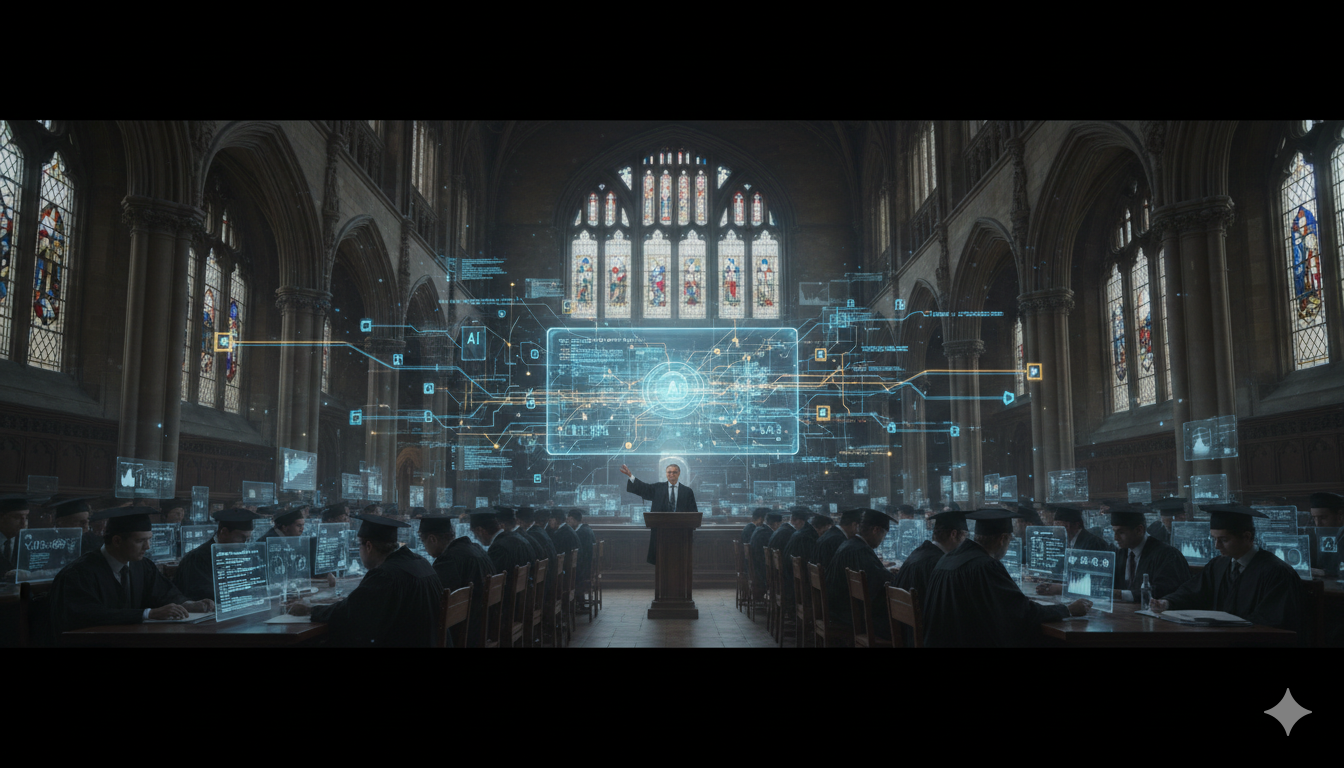
The Symposium: Oxford, March 2025
Seventh in a series about my AI lecture tour through Ivy League and international universities
Harry Potter Was Real
Being in Oxford was like stepping into a movie.
The oldest learning institutions in the English-speaking world, stacked on top of each other. Buildings sharing walls. Underground tunnels connecting who knows what. Fifteen hundred years of history everywhere you threw a stone.
They have these streetcars - old automobiles from the twenties, gutted and turned into wide-open carriage taxis. We took one through the city. Rolling through Oxford in what looks like a prop from a period film, passing buildings older than most countries.
My hotel sat in the direct center of the city’s oldest part. Extremely classy, low-key, beautiful. The kind of place that’s been hosting scholars for centuries.
The lobby was dark and classy - dark wood, low couches, beautiful chandeliers. The kind of place where you sink into a seat with a drink and just… exist for a while.
One evening, Emma Watson sat nearby with her dog - some kind of spaniel, cute little thing. She was just reading a book. Quiet. Unbothered.
I’m no stranger to stardom - spent the majority of my life in the entertainment business, stood on stage with actually pretty famous people. So seeing her didn’t make me want to fall over myself. What I thought was: she gets this everywhere, from everyone, all the time. It’s nice when someone can just feel human. Sit with her dog in a beautiful old hotel, read a book, drink something, be left alone.
I told the girl I was with: if I was going to say anything to her at all, it would be “What kind of dog is that?” That’s the most humanizing thing you can say to someone in that moment. Not “I loved you in Harry Potter.” Not “Can I get a photo?” Just… what kind of dog is that.
But I didn’t even say that. Just let the moment be what it was - sitting in Oxford, at this ancient crossroads of knowledge, with Hermione Granger reading quietly nearby. It felt appropriate somehow.
This place has been teaching people for a very long time. I was just the latest in a long line.
The Sharpest Questions
Oxford kids were different.
Not better or worse than the American students. Just… sharper in a particular way. They asked the deepest, most in-the-weeds questions of any audience on the tour.
The lecture itself was 85 minutes. But a good chunk of that became a symposium - them asking questions, me trying to keep up.
The Questions
I wish I could remember the specific questions. They were technical. Detailed. The kind of questions that made me think, not just answer.
These weren’t “what do you think about AI?” softballs. These were “what happens when you apply this technique to that edge case?” hardball questions.
The Oxford students had done their homework. Some of them probably knew more about specific corners of the field than I did. What I brought was breadth and practical experience - seeing how all the pieces fit together, knowing what actually worked in production.
The Tools Moment
March 2025 was a weird moment for AI tools.
New things were appearing constantly. Everyone was experimenting. Half the tools I showed them that day I don’t even use anymore - MSTY and others that seemed promising but didn’t pan out.
That’s the nature of this moment. You try everything. You share what’s working. Next month, something better appears and you move on.
I showed them my research techniques. How I was finding information. How I was evaluating new tools. The experimental process itself, not just the current winners.
That resonated. At Oxford, they understood that learning how to evaluate tools matters more than memorizing which tools are currently best.
The 85-Minute Marathon
This was my longest lecture of the tour.
I covered the convergence of AI and blockchain. Agentic workflows. The model landscape - Claude, GPT, Gemini, DeepSeek. Research techniques. Where I saw things heading.
But the real content came from the Q&A. The symposium format let the students drive the discussion into territories I hadn’t planned to cover.
That’s the Oxford style, I think. Not passive absorption. Active interrogation.
The Provenance Theme
I talked about provenance here too, like I had in Amsterdam.
As AI makes creation easy, proof of origin becomes crucial. Who made this? When? Can you verify it? Blockchain’s actual utility - not speculation, not tokens, but verification and provenance.
The Oxford students got it immediately. They were already thinking about the implications of generative AI for academic integrity, for creative ownership, for truth itself.
The Feeling
Oxford felt like a culmination.
Harvard was the debut. Cornell Tech was the validation. MIT taught me to communicate to business. NYU was the gasp moment. Amsterdam was the international connection.
Oxford was where it all came together. The material was polished. The audience was sharp. The conversation went deep.
If I had to pick one lecture from the tour that felt most complete, it would be this one.
What Stayed With Me
The specific questions faded from memory. What stayed was the quality of engagement.
Students who had prepared. Who challenged ideas rather than just accepting them. Who wanted to understand, not just be impressed.
That’s what great education looks like. Not lectures at students. Conversations with them.
Next: Princeton - the final stop, April 2025.
Date: March 19, 2025 Venue: Oxford University (Blockchain Society) Format: 85-minute lecture + extended Q&A symposium Audience vibe: Sharpest, most in-the-weeds questions Key tools shown: MSTY, various research techniques (experimental moment)